TL;DR
- The difference between
primary and secondary immunodeficiency lies in where the problem starts. Primary means a person was born with it, written into their genes. Secondary means something that happens later in life changes how the immune system works.
- Both can look identical from the outside: sinus infections that keep returning, pneumonia that comes back more than once, antibiotics that work and then stop working.
- Secondary forms are far more common, so an evaluation starts with a review of your medications and other diagnoses before anyone looks for a genetic cause.
- Testing means blood work, a review of your infection history, and often a check of how your body responds to a vaccine.
- Treatment differs by type. Secondary immunodeficiency sometimes improves when you address the underlying cause. Primary immunodeficiency is managed over the long term, often with immunoglobulin replacement.
Introduction
Immunology can now explain a pattern of infections that used to be treated episode by episode, by a different clinician each time. When we sort out
primary vs secondary immunodeficiency, we are answering a single question: did the immune system start this way, or did something change it later?
Primary immunodeficiency is genetic and present from birth. Secondary immunodeficiency is acquired, usually due to another illness, a medication, or a treatment for a separate condition.
We evaluate patients for both types of immunodeficiencies at our San Antonio clinic. The question we hear most at the first visit is not about treatment at all. It is "does this mean my kids are immunodeficient as well?" The answer depends entirely on which of the two we are looking at, which is why we spend the first appointment on history rather than on lab work.
If you already have a diagnosis and came here for the treatment section
Book An Appointment Now
The rest of you, read along to learn in detail about primary vs. secondary immunodeficiency.
What Is Immunodeficiency?
Immunodeficiency means the immune system cannot mount the defense it normally would. As a result, infections arrive more often, last longer, or come from organisms most people fight off easily. It is a functional description, not a single disease, and it covers a wide range of severity.
The immune problem usually sits in one of a few places:
- Antibody production, where the body makes too little IgG, IgA, or IgM, or makes antibodies that do not work well.
- Immune cells themselves, including T cells and neutrophils, attack infected cells directly.
- The signaling between them, where the parts exist but the instructions do not travel.
Antibody problems are what allergy and immunology practices see most, in both children and adults. They are also the ones where the split into primary and secondary matters most for what happens next.
What Is Primary Immunodeficiency?
Primary immunodeficiency is an immune system built with a piece missing or miswired because of a genetic variant a person was born with. It is also called an inborn error of immunity. Symptoms can start in infancy or remain silent for 30 years.
The category is larger than most people assume. The International Union of Immunological Societies counted
559 conditions across 508 genes in its 2024 phenotypic classification, published in April 2025. The National Institute of Allergy and Infectious Diseases estimates that primary immune deficiency diseases affect about
500,000 people in the United States.
Two forms account for most of what we see in adults:
- Selective IgA deficiency is the most common primary immunodeficiency, affecting roughly
1 in 500 people. Many people who have it never develop symptoms.
- Common variable immunodeficiency, abbreviated as CVID, involves low IgG levels, along with low IgA or IgM levels, and a poor antibody response. Most people with CVID are diagnosed between ages 20 and 40, and the diagnosis commonly arrives
5 to 8 years after the first clear symptom.
Recurring sinusitis simply gets treated as recurring sinusitis, one course at a time, until someone lines up the whole history on a single page. Our longer explainer on
primary immunodeficiency disorders covers each condition in more depth.
Common signs someone may have primary immunodeficiency
The signs of primary immunodeficiency are about pattern rather than count. A child with eight colds in a winter is usually a child in daycare. What draws our attention is when patients complain of:
- Two or more episodes of pneumonia or sinus infections requiring repeated courses of antibiotics in a single year.
- Infections that return quickly once the antibiotic course finishes, or that settle in the same place each time.
- Infections requiring intravenous antibiotics, or an unusual organism appearing on culture.
- Poor growth in a child alongside frequent illness.
- A family member already carrying an immune deficiency diagnosis.
Primary immunodeficiency symptoms also extend beyond infection. Autoimmune conditions, low platelet counts, and chronic digestive problems show up more often in this group.
Selective IgA deficiency is often found incidentally, especially during a celiac workup, since the standard celiac blood test depends on IgA. Patient arrives with a stomach complaint and leaves with an immunology question.
What Is Secondary Immunodeficiency?
Secondary immunodeficiency is a weakened immune response caused by external causes. The immune system was originally working fine, but a disease, a drug, or a physiological stressor reduced its capacity.
This is the far more common condition, and most of the causes are things adults already recognize from their own charts. Our
secondary immunodeficiency guide walks through each cause in detail.
Common causes of secondary immunodeficiency
Most cases trace back to a treatment or diagnosis the patient has already undergone. The usual causes:
- Medications
Corticosteroids, chemotherapy, and B-cell-depleting biologics used in autoimmune disease and cancer. Rituximab alone has been associated with low immunoglobulin levels in
11% to 67% of adult and pediatric patients in published cohorts.
- Blood Cancers
Chronic lymphocytic leukemia and multiple myeloma.
- HIV
The most studied cause of acquired immunodeficiency.
- Protein-Losing Conditions
Including some kidney and gut diseases that drain antibodies faster than the body can replace them.
- Malnutrition and significant undernutrition
Can reduce immune function worldwide.
Secondary immunodeficiency symptoms mirror the primary ones: recurrent sinus and chest infections, slow recovery, and infections that require stronger treatment than the situation warrants. The difference is in the timeline. In secondary immunodeficiency, symptoms usually begin after the triggering cause does, though patients rarely connect the two themselves.
Primary vs. Secondary Immunodeficiency
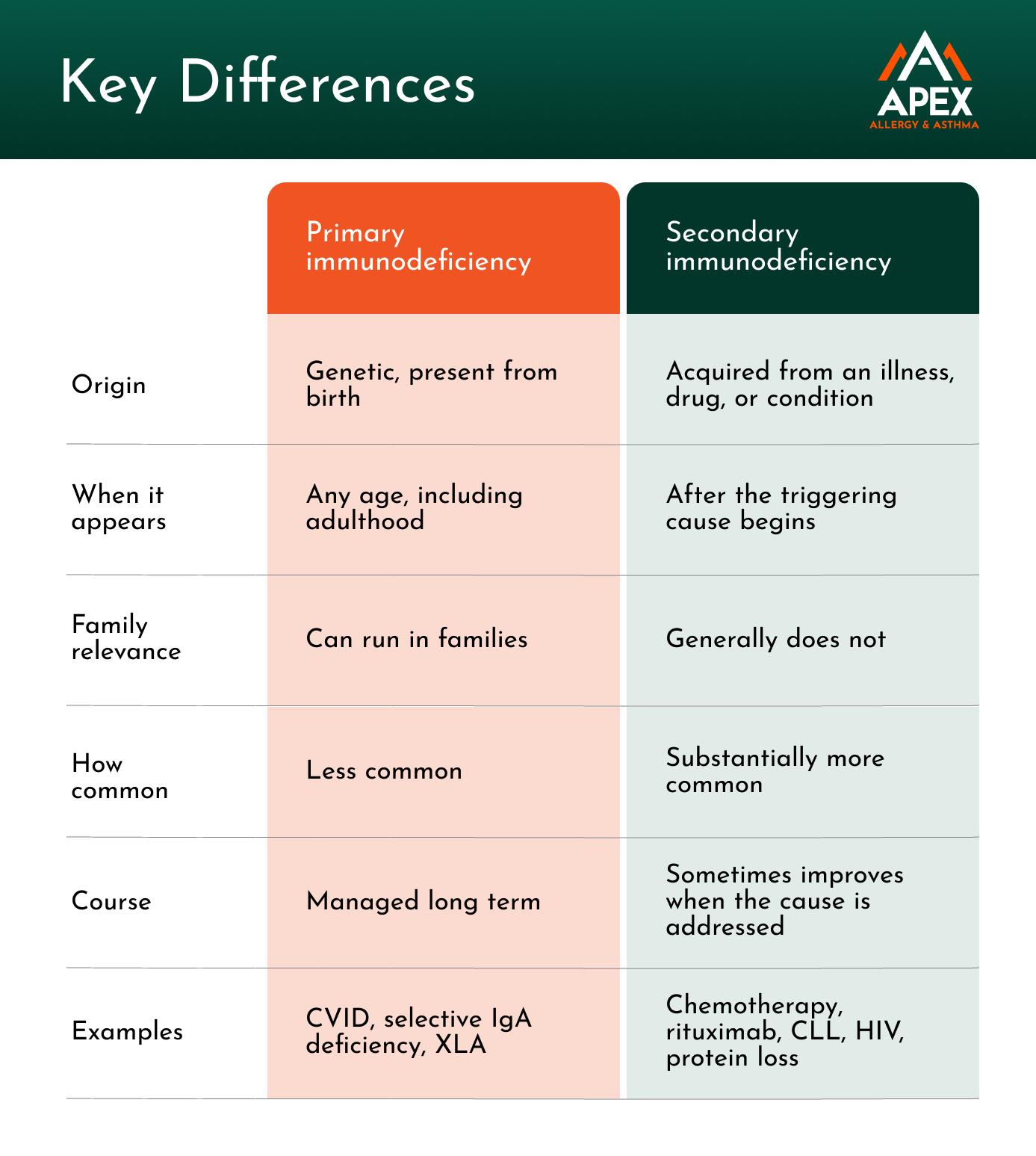
The difference between primary and secondary immunodeficiency comes down to origin, timing, family history, and whether treatment can alter the disease course. Here is the comparison we draw on paper during visits.
Secondary antibody deficiency is estimated to be roughly
30 times more common than primary antibody deficiency. That ratio is why an honest workup starts with the medication list rather than with genetic testing.
Shared Symptoms to Watch For
Primary and secondary immunodeficiencies produce nearly the same symptoms. Infections that keep coming back are what bring almost everyone into our office.
What we pay attention to:
- Antibiotic courses that repeat, especially four or more in a year for an adult.
- Sinus, ear, or chest infections that return within weeks of finishing treatment.
- Pneumonia more than once, or any infection needing hospital treatment.
- Chronic diarrhea, unexplained weight loss, or a new autoimmune diagnosis alongside the infections.
Two things we ask for directly, and you can gather both before your first visit:
- Pharmacy records rather than memory.
People undercount antibiotic courses, badly. A printed list from the pharmacy changes the conversation more often than any single lab value does.
- What else is being treated
Someone on long-term steroids for a rheumatologic condition is a different evaluation from someone with no medical history at all.
If that list matches your last two years, it is worth a conversation with an immunologist.
Book an Appointment with our San Antonio team, or call (210) 490-2051, and we will find a time that works for you.
How We Determine Which Type of Immunodeficiency You Have
Sorting primary and secondary immunodeficiency takes history plus blood work, in that order. We start with a full medication list, your other diagnoses, and a definitive count of infections and antibiotic courses over the past two years. Only then do the lab results add up to a conclusive diagnosis.
The workup typically includes:
- Immunoglobulin levels, measuring IgG, IgA, and IgM in the blood.
- A complete blood count with differential, which shows the white cells involved in immune defense.
- Vaccine response testing, where an immunologist checks how your antibodies respond to a vaccine you have already had or receive during the workup. This shows whether the system can mount a response on demand, rather than only whether the parts are present.
- A review of acquired causes first. The
AAAAI work group guidance on secondary hypogammaglobulinemia, published in 2022, recommends the same order of evaluation to rule out an acquired cause before treating the finding as inborn.
A first round of labs often comes back unremarkable. We repeat testing months later or while you are well, because steroid courses and recent illnesses move these numbers. Some evaluations run across a season. Some end with a clear clinical picture and no named genetic cause.
Treatment Approaches for Primary and Secondary Immunodeficiency
Primary and secondary immunodeficiency treatments start from different places. One manages a system that will not change. The other goes after a cause that sometimes can.
Primary immunodeficiency treatment centers on replacing what the body does not make and preventing infection. For antibody deficiencies, immunoglobulin replacement is the standard approach, administered intravenously or subcutaneously.
Published reviews report that immunoglobulin replacement therapy helps reduce the frequency and severity of infections in these patients.
According to the same review, subcutaneous dosing is now more commonly given at home and causes fewer systemic reactions than the intravenous route. Care also includes prompt treatment of infections, vaccination decisions with your immunologist, and monitoring for autoimmune and lung complications that accompany these conditions. We explain our guides to
IVIG infusion therapy and to
infusion centers in San Antonio.
Secondary immunodeficiency treatment begins with the cause. When a medication is responsible, the prescribing physician may adjust or change it, and immune function can recover. When the cause is a blood cancer or a protein-losing condition, treating the underlying condition is the primary lever.
Immunoglobulin replacement is also used to treat secondary antibody deficiency for patients who continue to develop serious infections despite other measures. Vaccination and preventive antibiotic strategies also belong to this conversation.
Immunoglobulin replacement supplies antibodies but does not repair the underlying genetic defect or reverse the condition that caused an acquired deficiency. It is ongoing care. For most people with primary antibody deficiency, immunoglobulin replacement continues for life.
Visit Apex Allergy and Asthma for Assistance
Most people arrive without knowing, and that is a reasonable place to start from. You do not need a diagnosis or even a referral; you need a question more specific than "these infections keep happening" to get an evaluation.
Apex Allergy & Asthma is a locally owned allergy, asthma, and immunology practice in San Antonio, led by Mark C. Stahl, DO. We see patients at our San Pedro Avenue and University Heights clinics and offer
immunodeficiency
evaluation and treatment for children and adults. Dr. Stahl reviews your antibiotic history, medication list, and prior labs before ordering anything new, because in this particular question, the history carries more weight than the first blood draw.
Ask your primary care physician for your visit history from the last two years, then count the antibiotic courses yourself.
Bring that number, your current medication list, and any prior immunoglobulin results to your first immunology appointment. If you want us to do that sorting with you,
Book an Appointment or call (210) 490-2051.
FAQs
What is the difference between a primary and a secondary immunodeficiency?
Primary immunodeficiency is genetic and present from birth, though it may go unrecognized until adulthood. Secondary immunodeficiency is acquired from factors outside the immune system, such as medications, blood cancers, HIV, protein loss, or malnutrition. Both produce similar patterns of recurrent infection, so history and testing, not symptoms alone, are needed to distinguish them.
Can secondary immunodeficiency turn into a permanent condition?
It can persist. Some causes lift when the trigger is treated, or a medication is changed by the prescribing physician, and immune function recovers. Other causes, including certain long-term therapies and some blood cancers, leave lasting antibody deficiency that needs ongoing management. How long it lasts depends on the cause, the duration of exposure, and the individual, so your immunologist monitors levels over time.
Can you have both primary and secondary immunodeficiency at the same time?
Yes, and it happens more than people expect. Someone with an undiagnosed primary antibody deficiency may start chemotherapy or a B-cell-depleting biologic, which lowers immune function further. The combination can also hide the original diagnosis, since an acquired cause offers an easy explanation. This is one reason immunologists review pre-treatment lab values when available.
Is IVIG therapy only for primary immunodeficiency?
No. Immunoglobulin replacement, given intravenously or subcutaneously, is well established for primary antibody deficiency and is also used for secondary antibody deficiency when patients continue to develop serious infections despite treatment of the underlying cause and preventive measures. Eligibility depends on immunoglobulin levels, vaccine response, infection history, and your insurer's criteria. Your immunologist makes that determination with you.
Do children only get primary immunodeficiency and adults only get secondary?
Neither is true. Primary immunodeficiency is genetic, so it is present from birth, but symptoms often stay mild until adulthood. CVID, the most common symptomatic form in adults, is usually identified between ages 20 and 40. Children can also develop secondary immunodeficiency from chemotherapy, immunosuppressive medications, or conditions that cause protein loss.
This article is for general education and does not replace medical advice. Talk with your physician about your symptoms, medications, and test results.